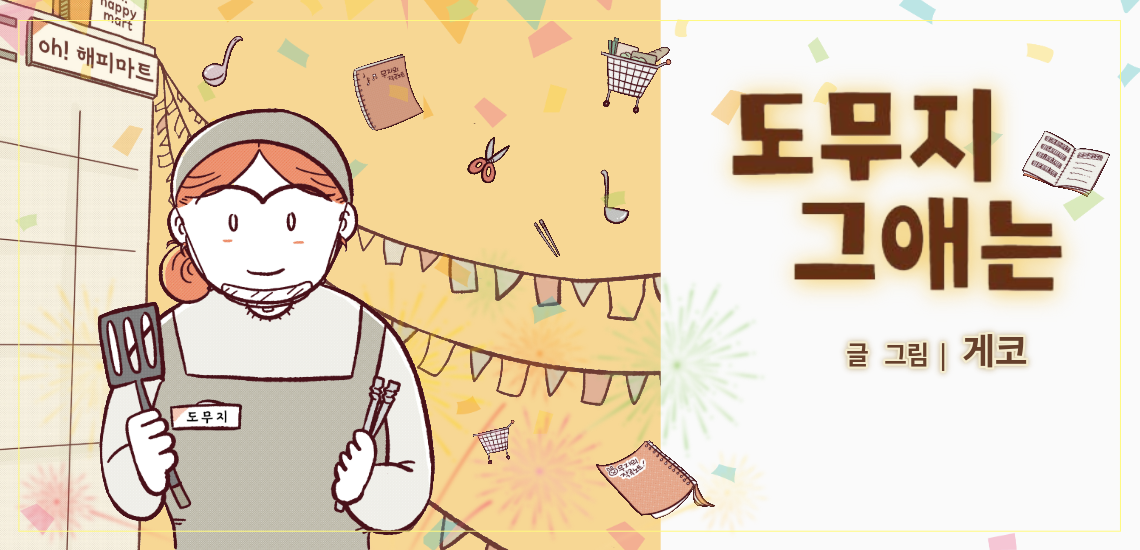
<That Girl, Domuji> Author Gecko Interview
Meet the Trending Author
vol. 255
[That Girl, Domuji]
Author Gecko | NAVER WEBTOON

A portrait of all of us silently enduring each day in this breathless reality! 👟💼
Twenty-nine, the most honest comfort and empathy drawn from the boundary of clumsy adulthood! ✨
An artist who paints a 'story' that pierces through life with a calm gaze and warm colors! ✒️
The interview with Author Gecko of <That Girl, Domuji>,
starts now.
[INTRO]
Q. Hello, Author Gecko! Thank you for agreeing to this interview! Before we begin, could you briefly introduce yourself?
A. Hello! I am Gecko, a webtoon author currently serializing a comic titled <That Girl, Domuji> every Friday on Naver Webtoon. I have recently wrapped up Seasons 1 and 2 and am taking a short break while preparing for the launch of Season 3. It's a pleasure to meet you!△ Hellooo~👋
[About Gecko]
Q. Is there a special reason or meaning behind your pen name, 'Gecko'?
A. 'Gecko' means lizard in English,
and thinking back to when I first created my pen name, I remembered the name of a blog I used to run.
A book that deeply impressed me as a child was titled 'Hotel Cactus' (a novel by Kaori Ekuni),
and since I liked lizards at the time, I took inspiration from the title of that book I enjoyed,
and named my blog 'Hotel Lizard'.
While pondering over a nickname for the blog, I intuitively went with 'gecko',
so the pen name 'Gecko' originated right from this 'Hotel Lizard'.
Since the pronunciation is similar, some people sometimes confuse 'Gecko' with 'Gaeko',
and they often mention Gaeko from the musician group Dynamic Duo!
I hope I can become a great artist like Gaeko too.😄
Q. You are currently taking a break after concluding Season 2. How are you spending your days?
A. I can confidently say it's rest first, rest second!
I'm reflecting on the challenging times during my creative process and thoroughly reorganizing my daily life,
so that I can successfully complete Season 3.
There isn't much time left until the launch, and right at this moment, I miss my readers so much!!
Q. When was the decisive moment you resolved to become a webtoon author?
A. I thought about this question for a long time.
Wondering if I ever had a decisive moment of resolving to become an author.
Honestly, when I first started doing webtoons, I didn't have the goal of debuting as a professional author.
From my teens to my twenties, it was my hobby to post little stories
in an essay format on my personal blog, and occasionally, I uploaded them as comics as well.
But one day, my dear older cousin told me,
'Tell your story to the (wider) world.' I remember her saying that.
Gaining courage from the support around me, I started irregularly serializing a piece titled 'Coffee and Smoothie'
on Naver Challenge Comics, and luckily, I got the opportunity to debut with that work.
When I received the serialization offer, I actually worried about whether I was qualified to be an author.
I felt I was lacking a lot at the time, and the scale of the word 'author' felt overwhelmingly huge to me.
(Even now, thinking of myself as an author feels a bit awkward and somewhat undeserved(?). Even though I am indeed an author who creates!)
△ Image Source: Gecko, cover of 『Coffee and Smoothie』 (YES24)
Since there wasn't a particularly impactful moment, the answer to your question might be a bit plain.
However, I believe I am someone who needs to live by telling 'stories' in one form or another.
It's probably closer to 'I'll die if I don't' rather than 'I absolutely must do this!'.🤭
Perhaps such insight into myself has led me to my current path?
The opportunity of official serialization itself is an incredibly valuable outcome for a creator.
I believe storytelling is my unchanging essence that permeates my time from a very young age until now.
△ Image Source: Naver Webtoon <That Girl, Domuji> / Author Gecko
Q. Where do you usually get inspiration to find material for your works?
A. My own experiences are definitely the number one source, and apart from that, I seem to get inspiration mainly through the lives around me.
In one episode of <That Girl, Domuji>, I wrote a narration saying, 'It is said that a person can neither see nor write what is not within themselves,'
and I think that is actually my own story told through the narrator, Muji.
The numerous experiences accumulated while living, and the meaningful thoughts gained through those experiences, serve as a source of big and small inspiration for me.
Also, Author Sinokio, who has been with me since Season 2, provides brilliant ideas, and I receive great help every time.
Whenever I feel stuck in the plot development, I hold idea meetings with the author,
and thanks to Author Sinokio, I believe the worldview of <That Girl, Domuji> has been able to expand further.
Q. Your realistic descriptions in the work are outstanding. Do you usually keep observation logs?
A. Absolutely! Since there are limits to my memory, I have a habit of taking notes right away whenever an idea comes to mind.
I mainly use a notepad app, and I have separate folders for each character in the work and each space where events occur.
This habit was a great help when conceptualizing the work <That Girl, Domuji>.
It was only when these big and small notes piled up to hundreds and thousands that I finally decided, 'This is it, I can write the piece now.'
△ Muji's days that closely resemble our daily lives
Q. What is your criterion for a 'good story'?
A. That's a very good question!
It seems to be the part I can answer most clearly among the interview questions.
There may be various criteria for a good story, but to me, a good story is an 'easy story.'
A story that can easily approach the public, reads smoothly without difficulty, as if someone familiar to me
is talking to me, unraveling a bundle of stories.
Furthermore, if that story allows me to look back on myself and my surroundings, and even raises questions about this world and society I live in,
I think it is truly the best possible work.
△ We all have days where we are comforted by a story someone told us ☘️
Q. Does the uniquely warm and calm color palette felt in your art style reflect a certain trait of yours?
A. I am honored that you view my drawings that way!
Rather than it being due to a special personal trait, I tried to use colors that matched the nature of the work.
Since it's a story dealing with tranquil daily life, I thought somewhat toned-down colors would fit better than flashy colors close to primary colors.
Q. What is a word from someone else that has brought you the greatest comfort?
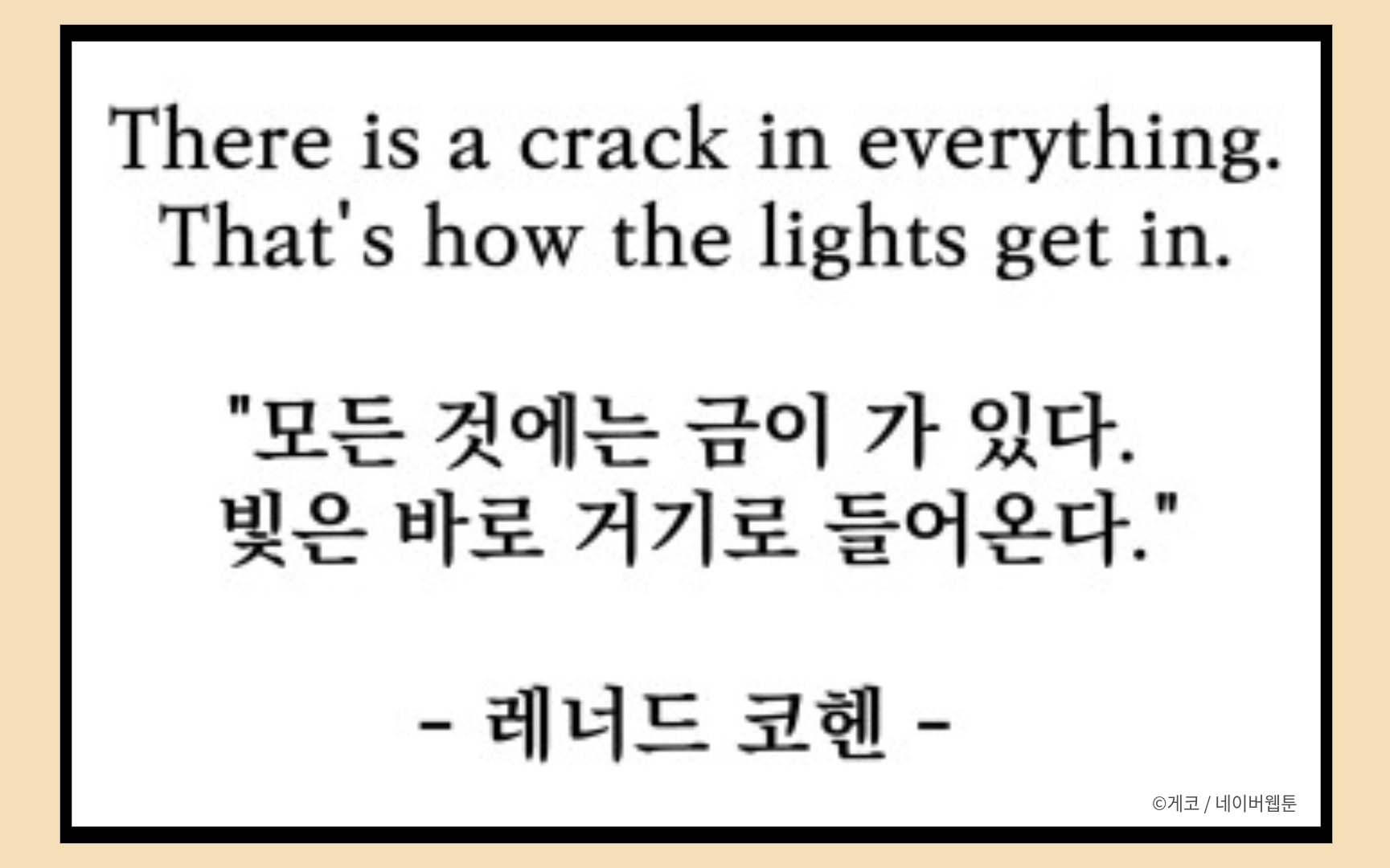
A. There is a lyric I quoted at the end of Episode 77 in Season 1, which is my favorite episode in <That Girl, Domuji>.
It's a line from the song 'Anthem' by musician Leonard Cohen.
“There is a crack, a crack in everything.
That’s how the light gets in“
There is a crack in everything, and that's exactly where the light enters.
I feel like this sentence always protects me.
Q. What do you hope Author Gecko looks like 10 years from now?
A. Even 10 years from now, I hope to still be someone who has stories I want to tell the world :)
Q. I'm curious about your workspace~! Please introduce it to us!
A. This is such a delightful question!
I recently moved my workspace to a shared office, so there isn't much to show, but I'd like to show you my previous workspace instead.
Although I've left it now, it was a space I painstakingly cultivated alone, so I had a lot of affection for it.
I'm glad to have the opportunity to show it to the readers.
△ The previous workspace filled with the author's affection 🎨
[About <That Girl, Domuji>]
Q. The word 'Domuji' (not at all), which is also the protagonist's name, implies a sense of utter bewilderment, like in 'I don't know at all.'
What was the first image that came to mind when you finalized this title?
A. As you mentioned, the title <That Girl, Domuji> holds a double meaning.
Although the source is not certain, I once heard an interesting story about the etymology of the word 'Domuji'.
They say there was a punishment called 'Domoji' a long time ago during the Joseon Dynasty.
It was a punishment where they placed sheets of water-soaked paper over the face of a sinner layer by layer and left them until it dried.
Ultimately, it's a quite cruel punishment that leads the sinner to suffocate to death,
and I heard that the word 'Domuji' originated to describe such a hopeless and helpless situation.
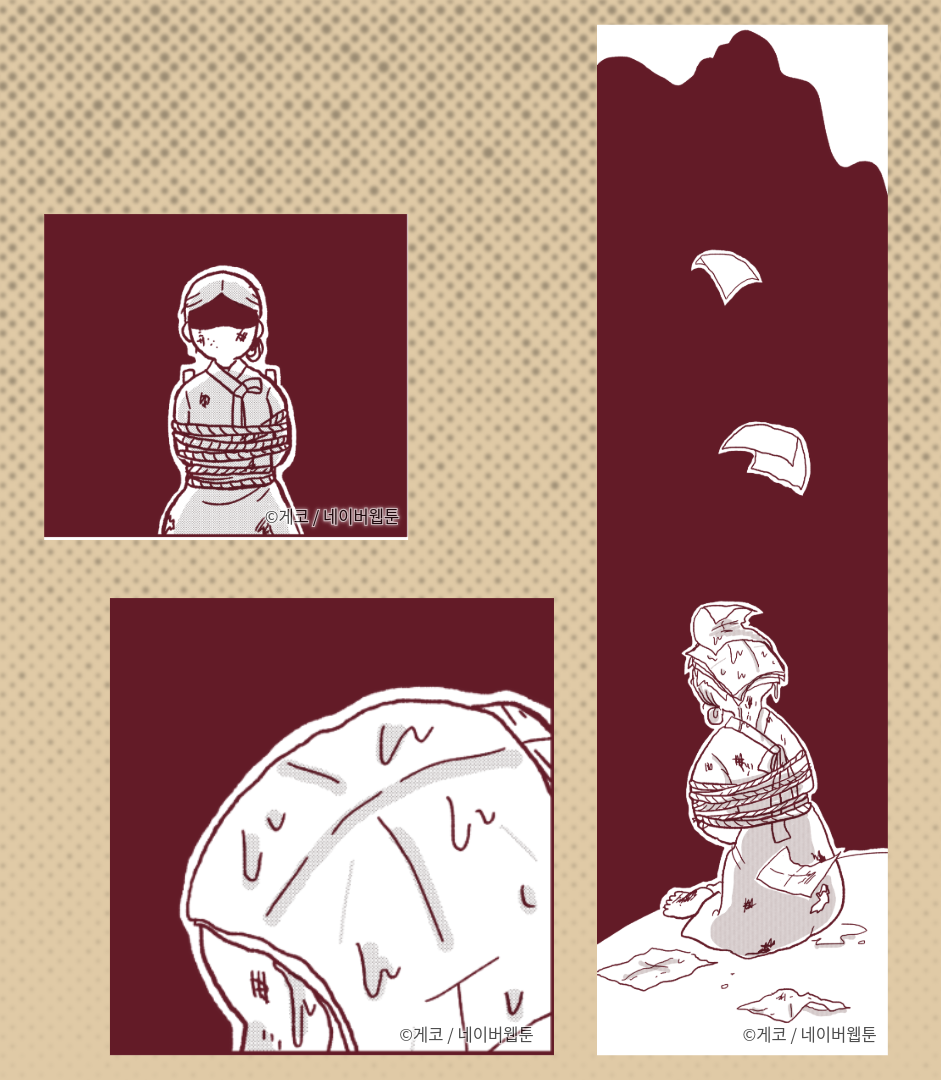
The protagonist's name derived right from the hopelessness that this word 'Domuji' conveys.
In the early parts of the story, everything is tough for Muji.
Her body and mind are worn out from long labor, and with a mother she needs to care for, her reality leaves no room to overcome burnout.
In such an environment, it can be said that she was generally quietly unhappy for years,
and in the sense that she was sinking into depression without realizing it,
I thought her situation was similar to the punishment 'Domoji', which slowly chokes you.
Originally, I unraveled this story in the prologue, but the tone of the work tended to become excessively dark, so I omitted it.
△ There are times when layers of paper feel heavier than any stone...💧
Q. You set the protagonist's age to 'twenty-nine', right on the threshold of thirty.
What symbolism does this age, placed between the end of youth and the beginning of adulthood, hold for the plot?
A. The age of twenty-nine is often referred to as the 'end of youth',
but actually, I believe it's an age where many people are still searching for their direction.
Socially, it feels like you should already be an adult, but it's a period where your heart is still shaky and closer to being clumsy.
That's why I set the protagonist's age to twenty-nine.
The protagonist, Muji, is not someone whose life is completely stable, nor is she a twenty-year-old with all possibilities open to her.
She endures day by day amidst responsibilities and reality, yet still agonizes over love, relationships, and the future,
living in a timeline that we either will experience or have already passed through.
'That Girl, Domuji' is a work where I wanted to depict the aspects of that period standing on such an ambiguous boundary.
It's a story of leaning on each other while not yet fully becoming adults, sometimes hurting each other, and growing while shaking and hurting like that.
Q. Did you personally research or experience anything for the vivid description of the part-time job scenes in the work?
A. Yes! Actually, I have experience working as an employee at a supermarket tasting corner in my late 20s.
At that time, I was also standing at the very end of my 20s, just like Muji in the work.
I just realized this while writing the interview, but I was exactly twenty-nine at that time too.
(It wasn't an intentional setting, but what a coincidence! It's surprising 😮)
Since it's a story derived from experience, the atmosphere, the people I saw while working on site,
and the unique rhythm of that space naturally melted into the scenes of the work, I guess.
I feel really good hearing you call it a vivid description!
Q. What enabled Muji to rebuild her broken daily life wasn't a grand success,
but the small warmth of others, like a casually tossed drink or nonchalant advice.
Are the 'warm adults' around who help 'Muji' based on real-life models?
A. Of course! Even now, as I write this interview, several faces come to mind.
Naturally, the older ladies I encountered while working at the mart come to mind first. My former teachers from my school days also pop into my head.
Personally, I often feel how important the presence of a 'good adult' is during the growth process.
Even if it's not some grand advice, a trivial word or a small kindness can sometimes become the driving force to live on for the days ahead.
Like this, the ladies and surrounding adults appearing in <That Girl, Domuji>
aren't heroes who solve Muji's difficulties at once, but they are people who share their warmth so she can briefly catch her breath
amidst a tough day.
I believe that love is not necessarily completed only when exchanged 1:1.
Rather than the affection I received returning only to the person who gave it,
I think it is also fully meaningful if it is passed on to someone else who needs it.
In that context, Muji also tries to become a similar presence for the character 'Yuchan'.
Not perfectly, but as a 'good adult' who, albeit clumsily, wants to pass on even a moment of warmth.
Just like the mart ladies are to Muji.
△ A soft and fuzzy feeling 🎈
Q. In the beginning of the work, the 'broken daily life' protagonist Muji experiences goes beyond simply feeling tired;
it approaches with a surreal sensation as if she alone is stalled in the world.
What was your inner driving force that allowed you to vividly implement such a helpless atmosphere?
A. I was also surprised about this while serializing,
but more readers empathized with the 'broken daily life' Muji experiences than I expected.
Perhaps it is a moment that many people pass through at least once in their lives.
A period where, outwardly, days continue without any major events, but you feel as if only you are momentarily stalled in the world.
I, too, seem to have experienced such times in my life.
There were times when daily life felt gradually heavier, and the strength to move forward wouldn't quite spark.
Perhaps the emotions and atmosphere of that time naturally permeated Muji's early narrative.
However, as I mentioned earlier, there is a crack in everything, and light is bound to enter through that gap!
I think the light that seeped into various parts of my cracked times guided me here.
I usually think 'there is no useless experience,' and seeing my big and small experiences become such an organic story
and come out to the world makes me feel newly grateful.
△ We are thankful to meet 'Muji' as well. 🥰
Q. This work goes beyond the story of a specific gender, dealing with the hardship and nobility of 'labor itself'—getting up every morning and heading to work.
What is the meaning of 'money earned honestly through sweat' and 'repetitive labor' that you think of?
In particular, I'm curious if there are common values you found between your creative labor as an artist and the physical labor Muji performs.
A. The expression 'money earned honestly through sweat' is really nice.
I feel that within those words, the time and effort a person endured through a day, along with the weight of life, are contained together.
Thinking back to the days I worked at the mart, repetitive labor was certainly not an easy task.
Working long hours standing up felt like my soles would burst, and my mouth would go completely dry from constantly pitching.
The exhausting air I walked through while looking up at the dark night sky on my way home is still vivid today.
However, at the same time, those hours were also a process that reconnected me with the world.
After finishing my first work and debut piece, 'Coffee and Smoothie', I actually didn't know if I would ever write a story again.
I was stuck in a state of 'not wanting to write any stories,' which I think is the most fearful moment for an author.
It was during this time of wandering and losing my way that I started working at the mart tasting corner,
and even within that hard labor, I found stories I wanted to tell again.
Just like Muji, who was frustrated by the weight of reality, grabbed her guitar again and started writing lyrics.
Since the act of creating a work is ultimately a time of repetition—returning to the same spot every day and building it up little by little—
looking back, creative work and physical labor don't seem much different.
The form is different, but I feel they are meaningful in that both forms of labor are a process of earning money through effort and leading one's life.
Therefore, in <That Girl, Domuji>, labor is not simply a job for livelihood,
but portrayed as a process where Muji recovers her life and connects with the world again.
I wanted to tell a story that in such a way, someone might gain the courage to live on once more.
△ 'Rose Shark' illustration _ excerpted from the author's Instagram
Q. Muji's growth happens so slowly it's barely noticeable.
What is 'living a good life' in your perspective, and how is the 'happiness' you define projected onto Muji's character in the work?
A. Hearing this question, a thought just flashed through my mind,
Recently, someone talked to me about happiness.
They said happiness lies in 'this very moment.'
Commonly, we tend to attach many 'conditions' to happiness, right?
For instance, we think we'll be happy if we win the lottery, get a partner, or pass an exam somewhere.
But happiness isn't about those things.
It’s not that you must possess something or reach a certain position; it is only happiness if you 'can be happy right now in this moment.' Hearing this,
I felt like I was struck on the head.
I also had a similar thought once, but it seems I lived forgetting that simple truth for a long time.
Just like the 'happiness of this moment' I mentioned, a 'good life' is also like that to me.
If I spent today without incident, and was grateful for the moment I have without meaningless worries and jealousy towards others,
I believe those days gather together to eventually become a 'good life.'
Q. What is the episode or scene that you personally feel most attached to?
A. As I briefly mentioned earlier, Episode 77, the final episode of Season 1, is the most memorable.
Across all episodes of <That Girl, Domuji>, if there's a character that tugs at my heartstrings the most, it's 'Hyuk'.
The reason is probably because he closely resembles me in certain ways.
To Muji, he was like Peter Pan, opening up a fantasy world slightly detached from reality,
yet he was a presence like Neverland that she absolutely had to leave in order to grow.
Episode 77 of Season 1 is an episode I agonized over repeatedly, wanting to give Hyuk, whom I cherish dearly, the most elegant exit possible.
(It was even better since the episode number happens to have two 7s, the number symbolizing luck!)
I always marvel at the wonderful comments readers leave, but the comments on Episode 77 are particularly touching.
△ Goodbye, Peter Pan
Q. Among the characters' dialogues, is there a line that stuck with you the most while drawing?
A. There are truly so many memorable lines!
What suddenly comes to mind right now is Muji's narration in Season 1, Episode 45, 'Where the Heart Holds On'.
Recalling her 20s, she expresses the time she had no options, saying, "They say it's an age where you can do anything, but I couldn't choose what to do,"
and she speaks of her lethargy and depression, saying, "Life after that was like a phone barely staying alive in power-saving mode."
Many readers also resonated with that episode, and reading their comments, I received comfort as well.
△ 🌈🖤
Q. What kind of webtoon do you hope this work will be remembered as by the readers?
A. You asked earlier what I consider a 'good story' to be.
It would be an honor if it is remembered as that kind of story I described.
Q. Countless readers are finding comfort by projecting themselves into Muji's life.
Do you have any words you'd like to share with the 'Muji's of this generation who silently live on like Muji despite the harsh reality?
A. A cartoonist speaks through cartoons!!!
(..which is ironic considering I'm pouring out all these long-winded words😅)
Jokes aside, actually I just want to tell you that you are already doing incredibly well just by enduring the present.
Sometimes we push ourselves, thinking we need to go further or be in better shape,
but I believe that during certain periods, simply living through the day without breaking down means you are trying hard enough.
Muji, too, moves forward not because she is an exceptionally great person,
but as a character who frequently stumbles and falls, yet somehow survives the given day as it comes.
So I want to tell the 'Muji's of this era as well, that I hope you don't feel too rushed.
Even if there are no noticeable changes right now, you are certainly moving forward, even if very slowly.
And if there is ever a day when life feels too pitch-black, I truly hope you remember this.
That there is a crack in everything, and that is exactly where the light gets in.
△ To everyone's shining days 🌈
[Outro]
Q. We are already looking ahead to Season 3.
Compared to your mindset when you first started serializing, what is the biggest change for you now?
A. Recently, I have been deeply feeling the importance of a 'routine.'
Actually, I think a regular lifestyle is the most important thing for creators.
Since we mostly work alone and the boundaries between commuting, working hours, and resting times are blurry, it's easy for the routine to break.
Since health collapses when the routine breaks, I felt that I need to focus even more on managing my condition during serialization.
I realized that good stories can't come out if I'm not healthy. I feel the need to frequently take care of both my body and mind.
Q. This is a work I would definitely want to own if it comes out as a physical book. Do you happen to have any plans for a printed volume?
A. I don't have any right now, but I am always waiting to publish a printed volume!
Publishers across the country, please give it a lot of interest!!😄
Q. Lastly, if you have any words you want to say to the readers who loved <That Girl, Domuji>, please go ahead and share them all.
A. I only have feelings of constant gratitude and fondness for the readers for watching over Muji's story.
I am still a very clumsy and lacking author, but I will strive to repay you with an even better work in the future.
Thank you. I love you!!
Watching Muji slowly move forward, we reflect on the single step we took today.
Thank you for joining us for this long interview.🎉